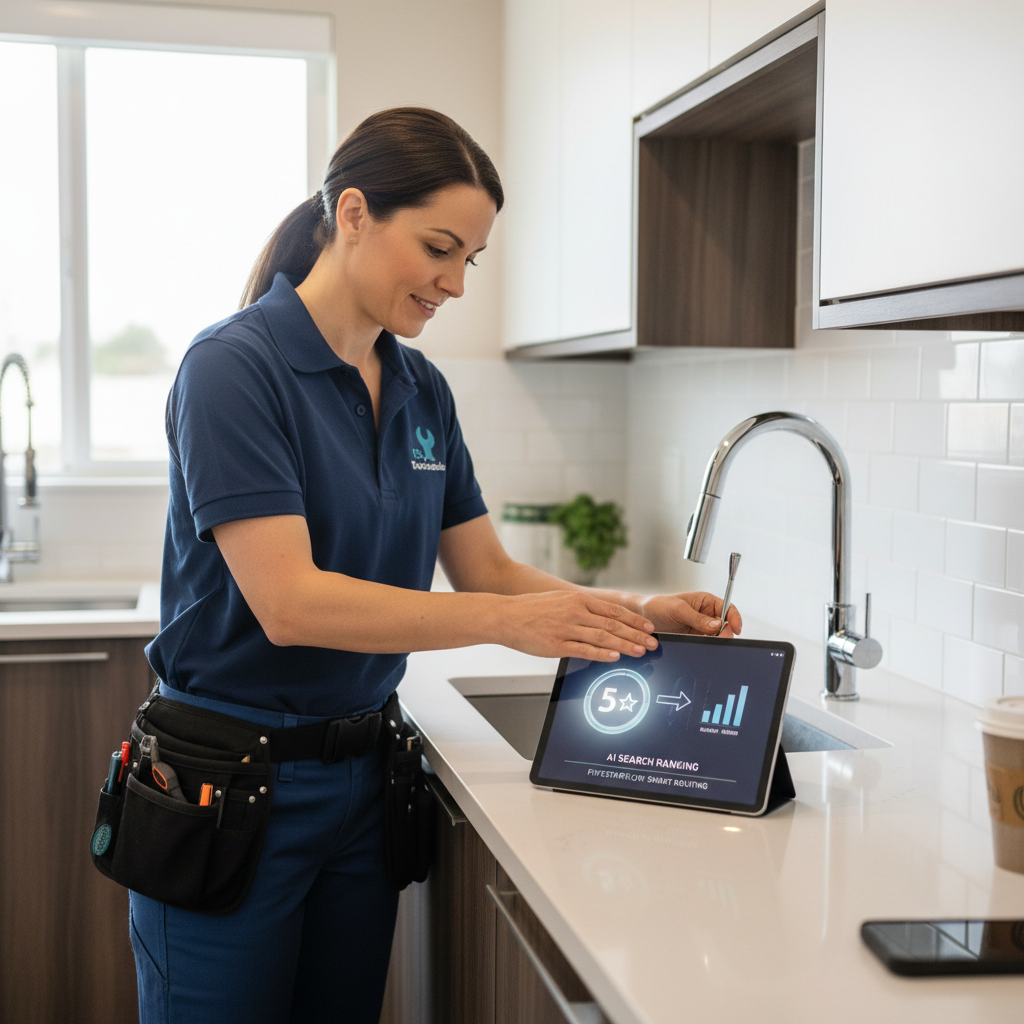
Your phone used to ring from Google Maps. Now customers are asking ChatGPT "who's the best HVAC company near me" and getting a short list of recommendations — and your business may not be on it. If you haven't started thinking about how reviews affect AI search rankings for local businesses, this is the moment. The rules changed quietly, and most of your competitors haven't caught on yet. That's your window.
AI Search Is Already Sending Customers to Local Businesses — Just Not Yours (Yet)
ChatGPT, Perplexity, Google's AI Overviews, and similar tools are now answering "who should I hire" questions with real business recommendations. This isn't a future trend. It's happening right now. Someone in your service area is asking an AI assistant for a plumber, a pest control company, or a cleaning service, and that AI is making a call on who to recommend.
What most business owners don't realize is that these AI systems aren't pulling recommendations out of thin air. They're drawing from a combination of structured web data, review platforms, and the overall reputation footprint your business has built online. A business with 200 Google reviews and a strong rating doesn't just rank better on Google Maps — it gets surfaced more often when AI tools scan the web to build their answers.
The businesses winning in AI search right now are the ones with consistent review volume, high ratings, and fresh reviews coming in regularly. Not because some algorithm was tuned for it — but because review signals are a reliable proxy for trustworthiness, and AI systems are trained to surface trustworthy sources.
How Reviews Affect AI Search Rankings for Local Businesses: The Mechanics
Here's the short version: AI language models are trained on massive amounts of web content. That content includes Google Business Profiles, review aggregator sites, local directories, and forum discussions. When a model learns to answer "who is the best pest control company in Austin," it's pattern-matching against everything it's seen about pest control companies in Austin — and businesses with high review counts, strong sentiment, and mentions across multiple platforms consistently show up in those patterns.
There are three specific signals that matter most:
Review volume. A business with 300 reviews is referenced more across the web than a business with 12. More references mean more weight in AI training data and real-time retrieval systems.
Review sentiment. It's not just about having reviews. AI tools can read whether your reviews are positive or negative. Businesses with consistently glowing reviews — especially ones that mention specific services — get surfaced more confidently as recommendations.
Recency. Stale reviews matter less. A business that received 50 reviews two years ago and nothing since reads as dormant. AI systems prioritize businesses that appear actively engaged with their customers.
The compounding effect is significant. More reviews → more web mentions → more AI citations → more customers → more reviews. Getting into that flywheel early is a real competitive advantage.
The Problem With Most Review Strategies (And Why They Backfire)
Most local service business owners know they should be getting more reviews. The problem is execution. You finish a job, you mean to send a follow-up, and then the next job starts and it never happens. Or you send a review request and the customer who was actually unhappy — the one who didn't say anything to your face — is the one who takes the time to leave a one-star review on Google.
That second scenario is the one that kills you. One bad public review can undo dozens of good ones in the eyes of a potential customer. And in the eyes of AI systems pulling sentiment data, a cluster of negative reviews doesn't just hurt your star rating — it affects the confidence with which AI tools recommend your business at all.
Most review collection tools treat every customer the same way: send a link, hope for the best. That's where the smart money is moving away from.
Smart Routing: The Feature That Separates Review Generation From Review Management
This is where FiveStarFlow does something most tools don't. Instead of blasting every customer to your public Google review page, FiveStarFlow uses smart routing to filter the experience based on how satisfied the customer actually is.
Here's how it works in practice. You finish a job. You hand the customer a QR code or trigger an automated SMS follow-up. The customer sees a simple question: how was your experience? If they indicate they're happy, they're taken directly to your Google review page. If they indicate they're not satisfied, they're routed to a private feedback form that comes directly to you — not to Google, not to Yelp, not anywhere public.
The result: your happy customers go public, your unhappy customers give you a chance to fix it first. You protect your rating while still hearing the feedback you need to improve. That's not just good for reputation management — it's good for your actual business operations.
And from an AI search perspective, the impact is direct. Higher average rating. More consistent positive sentiment in your reviews. Steady volume of new reviews coming in. All three are signals that help answer the question of how reviews affect AI search rankings for local businesses — and FiveStarFlow is building those signals systematically every time you complete a job.
Setup Takes Two Minutes. The Compounding Effect Takes Months. Start Now.
The most common objection business owners have is time. You're running crews, handling dispatch, dealing with suppliers, and chasing invoices. Adding a new system to learn feels like one more thing.
FiveStarFlow was built with that objection in mind. Setup takes about two minutes. You connect your Google Business Profile, choose whether you want QR codes, SMS follow-ups, or both, and you're live. The automation handles the rest. Every job you complete starts feeding the review funnel automatically — no manual follow-up, no chasing customers, no remembering to send links.
At $29–$79 per month, depending on what you need, this is the kind of tool that pays for itself the first time a customer tells you they found you through a Google search — or, increasingly, through ChatGPT. The math isn't complicated. One new job per month covers the cost. Everything else is margin.
The businesses that start building review volume now will have a compounding advantage 12 months from now that their competitors won't be able to close quickly. AI search engines aren't just looking at today's reviews — they're looking at the full reputation footprint. Businesses that started early have deeper footprints. That's a moat you want to build before your competitors figure this out.
What This Looks Like for a Real Service Business
Picture a pest control owner running three trucks. Before FiveStarFlow, they had 34 Google reviews — decent for their market, but not dominant. They were doing good work, customers weren't complaining, but nobody was leaving reviews. They were invisible in AI search results for their area.
Six months after setting up automated SMS review requests with smart routing, they're at 190 reviews with a 4.8 average. Three different customers mention they found them through "an AI search" or "ChatGPT suggested you." Their Google Maps ranking improved too — reviews are a traditional ranking signal as much as they're an emerging AI signal. They didn't change their service. They changed how systematically they collected proof of it.
That's not a hypothetical outcome. That's the direct result of understanding how reviews affect AI search rankings for local businesses and acting on it with the right tool.
The window to get ahead of your local competitors on AI search is open right now. It won't stay open. The businesses that move first on review volume and quality will hold that ground. The businesses that wait will be playing catch-up against a compounding lead that gets harder to close every month.
If you run a pest control company, HVAC business, cleaning service, landscaping operation, or plumbing company — and you want to be the name that comes up when someone in your area asks an AI who to call — the first move is fixing your review pipeline. Start your free trial at FiveStarFlow. Setup takes two minutes, the smart routing runs automatically, and you'll be building the exact kind of review footprint that gets local service businesses recommended in AI search. Stop leaving that ground to your competitors.